What Treasury’s Proposed Reforms Could Mean for Climate Reporting
October 1, 2026
In August 2026, Treasury released a consultation paper, Improving the efficiency of climate-related financial disclosures, proposing a set of reforms to Australia’s mandatory climate-related financial disclosure regime. The reforms are intended to reduce compliance costs for reporting entities while preserving the quality, credibility and international comparability of sustainability reporting. Submissions close on 2 October 2026.
The consultation paper sets out three areas for potential reform: adjusting the assurance settings, improving consistency in the application of existing requirements, and setting clearer boundaries on value-chain information requests.

Proposal 1: Adjusting assurance settings
Under the Corporations Act, a reporting entity’s sustainability report must be independently assured, with the auditor’s report on the climate statements lodged alongside it. The assurance must be provided by a registered company auditor, a professional registered with ASIC to audit company financial reports. It doesn’t need to be the entity’s existing financial auditor.
The conduct of the engagement is governed by ASSA 5000 (General Requirements for Sustainability Assurance Engagements), while the level and timing are set by ASSA 5010 (Timeline for Audits and Reviews of Information in Sustainability Reports under the Corporations Act 2001). The framework provides for two levels of assurance, distinguished by the extent to which the auditor reduces engagement risk.
- Limited assurance: involves a review of the disclosures. It applies fewer and less extensive procedures and results in a negative form of conclusion, in which the auditor states that nothing has come to their attention to suggest the disclosures are materially misstated. It provides a moderate level of confidence.
- Reasonable assurance: involves a more detailed examination of the underlying data and the controls supporting it, and results in a positive opinion that the information is free from material misstatement. It provides a high, though not absolute, level of confidence.
Assurance requirements are being phased in over time, moving from limited assurance initially to reasonable assurance for financial years commencing on or after 1 July 2030.
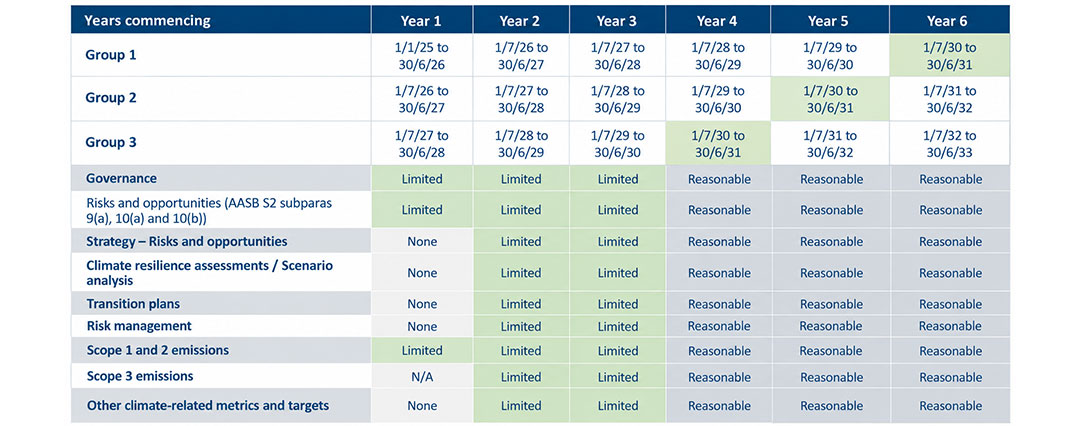
Treasury is consulting on three options for adjusting this pathway:
- Option 1a would make limited assurance the permanent requirement, removing the transition to reasonable assurance altogether.
- Option 1b would retain the transition but defer it from 2030 to 2035, allowing further time for market capability and data maturity to develop, consistent with the position adopted in the European Union.
- Option 1c would introduce a tiered model, under which reasonable assurance would be required only for more mature metrics. In practice, this would mean reasonable assurance over Scope 1 and Scope 2 emissions, with Scope 3 emissions remaining subject to limited assurance, in recognition of their greater reliance on third-party data.
Proposal 2: Consistent application of existing requirements
Early implementation feedback suggests that some aspects of the disclosure and assurance standards have been difficult to apply in practice. Treasury does not propose to amend AASB S2 or the legislative definitions. Instead, it seeks views on additional guidance and educational resources to clarify how existing requirements apply. The areas identified for additional clarity include:
- the proportionality mechanisms in AASB S2, in particular “reasonable and supportable information without undue cost or effort” and action “commensurate with the skills, capabilities and resources that are available to the entity”;
- the circumstances in which an entity may conclude that it has no material climate-related risks or opportunities, and the evidence and governance required to support that conclusion; and
- how assurance should be approached where an entity relies on those mechanisms or makes a no-material statement.

Proposal 3: Clearer boundaries on value-chain information requests
Scope 3 emissions must be disclosed from an entity’s second reporting year and are subject to the “reasonable and supportable information without undue cost or effort” threshold. Treasury is considering how to prevent requests for Scope 3 data from imposing a disproportionate burden on suppliers, particularly small and medium-sized businesses. The options under consideration include:
- additional guidance to help determine appropriate boundaries, along with practical examples of what constitutes a reasonable request for information from a value chain, and how proportionality should apply; and
- a greater role for government in developing or collecting reliable domestic emissions factors to improve access to secondary data and reduce entities’ reliance on primary data collection across their value chains.
Other potential avenues to improve efficiency
Beyond the three main proposals, the paper welcomes advice on other ways to improve the efficiency of the regime and identifies two such opportunities:
- Alignment between domestic frameworks and AASB S2. Entities whose financial year does not end on 30 June can face duplicated effort where their sustainability reporting period differs from their National Greenhouse and Energy Reporting (NGER) period. The government is seeking views on the practical challenges this creates and whether existing flexibilities are sufficient to manage them.
- Registered company auditor practical experience requirements. Stakeholders have noted that the experience requirements for becoming a registered company auditor may affect the cost and availability of sustainability assurance practitioners. The government is seeking views on whether that experience pathway should recognise sustainability assurance work, and whether a sustainability report auditor should face the same requirements as a financial report auditor.
What this means for reporting entities
The proposed reforms will not affect entities reporting for the 2026–27 financial year, which is already underway. Group 2 entities should therefore continue preparing under the existing requirements.
Separately, the 2026–27 Budget proposed raising the large proprietary company thresholds to $100 million in revenue (from $50 million) and $50 million in gross assets (from $25 million), with the employee threshold unchanged. If implemented, this would remove some smaller Group 3 entities from mandatory sustainability reporting.
For entities that have already invested in preparing for limited or reasonable assurance, that work is not lost under any of the proposed options. Independent assurance will remain a core feature of the regime whichever option Treasury adopts, and it relies on the same foundations either way: complete, well-documented data and the governance behind the disclosures.
How Cress can help
Cress helps organisations across the full scope of AASB S2 preparation, from understanding reporting requirements and assessing readiness through to greenhouse gas inventories, climate-related risk and opportunity assessments, scenario analysis, and establishing governance arrangements.

We can also help organisations strengthen the underlying data, processes, controls and documentation needed to support credible, assurance-ready reporting.
Get in touch to discuss how we can support your business.
Cress is the Hydroflux Group’s in-house sustainability consulting team, operating as a specialised division and driven by a simple but powerful goal: to help organisations across Australia, New Zealand and the Pacific region create a more sustainable future. As a young and agile team, we combine technical expertise with fresh, forward-thinking approaches to help clients navigate complex challenges across climate risk, emissions reduction, modern slavery, water stewardship, and ESG reporting, building on the Hydroflux legacy of engineering excellence while bringing a sustainability lens to the industries and communities shaping the future of our region.
Up Next

Australia’s Data Centre Boom is Reshaping Energy and Water Demand