

Regulations and Standards Hub
This hub provides an overview of the regulations and voluntary standards currently governing sustainability strategy, climate risk, carbon accounting, ESG reporting, and modern slavery. Contact us to understand what may apply to your organisations context and explore how Cress can assist.
Australian Regulatory Requirements
Applies to: Entities that are required to prepare an annual financial report under Chapter 2M of The Corporations Act and meet the sustainability reporting thresholds.
The Corporations Act 2001 (Cth) requires certain entities to disclose climate-related financial information as part of their annual reporting. These disclosures must be prepared in accordance with the Australian Sustainability Reporting Standards (ASRS), issued by the Australian Accounting Standards Board (AASB).
The ASRS comprises two standards:
- AASB S1, General Requirements for Disclosure of Sustainability-related Financial Information (voluntary)
- AASB S2, Climate-related Disclosures (mandatory)
Both are based on the International Sustainability Standards Board (ISSB) framework, which incorporates the recommendations of the Task Force on Climate-related Financial Disclosures (TCFD), adapted to the Australian legal and institutional environment.
What must be disclosed?
AASB S2 requires entities to disclose their climate-related risks and opportunities, including physical and transition risks that could affect the entity’s cash flows, access to finance, or cost of capital over the short, medium, or long term.
Disclosures must be structured around four pillars:
- Governance: the roles, responsibilities, and oversight structures in place across management and the board.
- Strategy: how climate-related risks and opportunities affect the entity’s business model, strategy and financial position, and the resilience of that strategy when assessed against at least two climate-related scenarios.
- Risk Management: the processes used to identify, assess, prioritise, and monitor climate-related risks.
- Metrics and Targets: Scope 1, Scope 2, and Scope 3 greenhouse gas emissions, alongside other climate-related metrics used to monitor exposure to physical and transition risks, and the targets set and progress against them.
Reporting entities must prepare a Climate Statement alongside a Director’s Declaration of compliance and an auditor’s report, to be lodged with the entity’s financial report.
Who is required to report, and when?
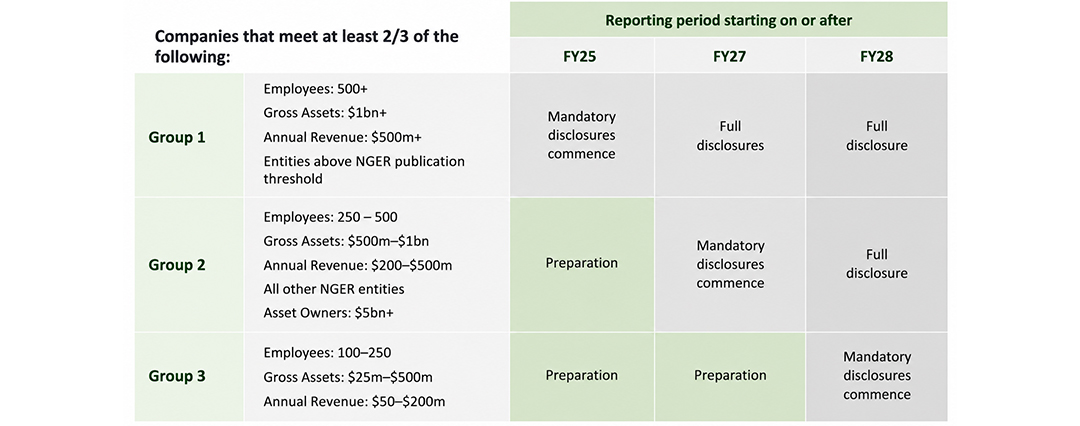
Mandatory climate reporting is being phased in across three reporting groups, based on an entity’s first annual reporting period. Reporting thresholds are outlined below.
Assurance
Sustainability reports are subject to independent assurance under standards ASSA 5000 and ASSA 5010 issued by Australian Auditing and Assurance Standards Board (AUASB). Assurance requirements are phased in progressively, moving from limited to reasonable assurance over successive reporting years. Reasonable assurance applies across all disclosures for reporting periods commencing on or after 1 July 2030.

Non-compliance
The Australian Securities and Investments Commission (ASIC) is responsible for enforcing AASB S2 under the Corporations Act 2001 (Cth). Non-compliance may result in ASIC directing an entity to correct, complete, or amend a sustainability report, the issue of infringement notices, and civil penalty proceedings against the entity and its directors.
For more information, refer to “Our Sustainability Consulting Services”
Applies to: Entities with annual consolidated revenue of A$100 million or more.
The Modern Slavery Act 2018 (Cth) requires reporting entities to prepare an annual Modern Slavery Statement addressing their approach to identifying and managing modern slavery risks in their operations and supply chains. Entities below the reporting threshold may also submit a statement on a voluntary basis.
What must be disclosed?
The Statement must address seven mandatory criteria:
- Identify the reporting entity.
- Describe the entity’s structure, operations, and supply chains.
- Describe the risks of modern slavery practices in the operations and supply chains of the reporting entity, and of any entities it owns or controls.
- Describe the actions taken to assess and address those risks, including due diligence and remediation processes.
- Describe how the entity assesses the effectiveness of those actions.
- Describe the process of consultation with any entities it owns or controls (and, for a joint statement, consultation with the entity giving the statement).
- Include any other information the entity or higher entity giving the statement considers relevant.
Reporting requirements and deadline
The Statement must be approved by the entity’s principal governing body and submitted within six months of the end of the entity’s reporting period. Approved statements are published on the Modern Slavery Statements Register, a publicly accessible database administered by the Attorney-General’s Department.
Non-compliance
The Act does not currently impose financial penalties for non-compliance.
Applies to: Private sector and Commonwealth public sector employers with 100 or more employees for at least six months of the reporting period.
The Workplace Gender Equality Act 2012 (Cth) requires relevant employers to register with WGEA and lodge an annual Gender Equality Report. Employers that directly employ 500 or more employees are classified as Designated Relevant Employers and are subject to additional requirements, including selecting and reporting progress against gender equality targets.
What must be disclosed?
The Gender Equality Report comprises:
- An Employer Questionnaire covering the organisation’s policies and strategies across six gender equality indicators: workforce composition; pay equity; governing body composition; flexible work and caring support; consultation on gender equality; and sexual harassment and discrimination.
- A Workplace Profile (WPP), providing a snapshot of the organisation’s workforce, including salary and remuneration data.
- Workforce Management Statistics (WMS), covering employee movements such as appointments, promotions, resignations, and parental leave.
Reporting requirements and deadline
WGEA reporting is governed by two timeframes: the reporting period, during which the relevant workplace data is collected and compiled, and the lodgement period, during which the completed report must be submitted.
Reporting period: 12-month timeframe from 1 April to 31 March for the private sector and 1 January to 31 December for the Commonwealth public sector
Lodgement period: reporting entities must lodge their reports within the submission window that runs from 1 April to 31 May each year, following the close of the reporting period.
The completed Public Report requires CEO sign-off before it can be officially lodged.
Non-compliance
Non-compliant employers may be named publicly by WGEA, will not receive a Certificate of Compliance, and may be ineligible to tender for Commonwealth contracts or to receive Commonwealth grants or other financial assistance.
Applies to: Entities exceeding facility or corporate group thresholds for greenhouse gas emissions, energy production, or energy consumption.
The National Greenhouse and Energy Reporting Act 2007 (Cth) established the National Greenhouse and Energy Reporting (NGER) Scheme, which governs how emissions and energy data is measured, verified, and reported at the facility and corporate level.
Who is required to report, and when?
An entity must register and report under the NGER Scheme if it exceeds either of the following thresholds:
- Facility threshold: 25,000 tonnes CO2-e or more Scope 1 and Scope 2 emissions, or 100 TJ or more of energy production, or 100 TJ or more energy consumption.
- Corporate group threshold: 50,000 tonnes CO2-e or more of Scope 1 and Scope 2 emissions, or 200 TJ or more of energy production, or 200 TJ or more of energy consumption.
Reporting requirements and deadline
Registered corporations must report their Scope 1 and Scope 2 greenhouse gas emissions, energy production, and energy consumption to the Clean Energy Regulator annually, by 31 October.
Non-compliance
Non-compliance may trigger an audit by the Clean Energy Regulator, with regulatory action and financial penalties available for up to five years after a report is submitted.
International Regulations
Jurisdiction: Aotearoa New Zealand
Applies to: Entities operating in Aotearoa New Zealand with annual revenue of NZ$100 million or more.
As drafted, the Bill would require entities that fall under the criteria to publish an annual modern slavery statement, disclosing actual modern slavery incidents, complaints, and remediation outcomes. Unlike the Australian Act, the Bill imposes penalties: a reporting entity that fails to submit or publish a statement, or that knowingly makes a false or misleading statement, commits an offence and may be liable for a criminal fine of up to NZ$200,000. The High Court may also, on application, order the entity to pay a civil pecuniary penalty of up to NZ$600,000.
The Education and Workforce Select Committee reviewed the Bill and recommended it be passed with amendments.
Jurisdiction: European Union
Applies to: Large EU entities with more than 1,000 employees and net turnover exceeding €450 million
The CSRD is the EU directive that requires certain entities to report detailed sustainability information, with the ESRS setting out what must be disclosed. Reporting covers environmental, social, and governance topics under a double materiality approach: an entity must assess both how sustainability issues affect its financial position (financial materiality) and how its operations affect people and the environment (impact materiality). This double materiality assessment is itself a requirement; its outcome determines which disclosure standards and topics the entity must report against.
First-time application under the revised scope is required for financial years beginning on or after 1 January 2027.
Voluntary Standards and Frameworks
The standards and frameworks below are not mandated by Australian law. An organisation may choose to adopt them to strengthen governance, meet stakeholder or supply chain expectations, and demonstrate credible progress on sustainability commitments.
Jurisdiction: Australia
Topic: Sustainability reporting (general)
Established by: Australian Accounting Standards Board (AASB)
AASB S1 General Requirements for Disclosure of Sustainability-related Financial Information provides a voluntary framework for the disclosure of sustainability-related risks and opportunities, including environmental, social, and governance (ESG) factors that may affect an entity’s financial performance. Disclosures are structured around the same four pillars as AASB S2: Governance, Strategy, Risk Management, and Metrics and Targets.
Why might an entity choose to apply this standard?
Voluntary adoption of AASB S1 enables an organisation to strengthen governance, enhance resilience by preparing for sustainability-related risks, and demonstrate accountability through transparent reporting beyond climate. Early alignment with AASB S1 can help an organisation address material ESG risks, meet stakeholder expectations, strengthen its reputation, and support long-term value creation.
Jurisdiction: International
Topic: Sustainability reporting (general)
Established by: Global Sustainability Standards Board (GSSB), part of the Global Reporting Initiative.
The GRI Standards are the most widely adopted global framework for sustainability reporting. They require an organisation to disclose its economic, environmental, and social impacts based on a materiality assessment, using the concept of impact materiality: an organisation’s most significant effects on the economy, environment, and people, rather than the financial effects of sustainability issues on the organisation itself. Reporting entities identify material topics relevant to their operations and disclose against the corresponding indicators, using a GRI content index to demonstrate coverage.
Why might an entity choose to apply this framework?
Reporting against the GRI Standards allows an organisation to disclose its impacts through a recognised, consistent lens, making its disclosures comparable with peers globally. GRI provides detailed, standardised indicators to report against, giving organisations a concrete basis for disclosure. Its Sector Standards further help entities identify the topics most likely to be material to their industry, strengthening the materiality assessment and improving comparability within a sector.
Jurisdiction: International
Topic: Climate and emissions reduction
Established by: A partnership between CDP, the United Nations Global Compact, the World Resources Institute (WRI), and the World Wide Fund for Nature (WWF)
The Science Based Targets initiative (SBTi) is a global body that independently validates corporate greenhouse gas emissions reduction targets against climate science. An organisation reporting under SBTi must develop emissions reduction targets in line with SBTi’s methodology, submit targets for validation, and report progress annually. For organisations reporting under standards such as AASB S2 and the EU’s ESRS, which require disclosure of any targets set; SBTi provides the methodology for setting those targets and independent validation that they align with climate science.
Why might an entity choose to apply this standard?
SBTi validation confirms that an organisation’s emissions reduction targets are aligned with what climate science indicates is needed to limit global warming, giving investors, customers, and regulators independent assurance that targets are credible. It can help an organisation secure green financing and reduce exposure to greenwashing claims, since targets are assessed by an independent third party against a recognised methodology.
Jurisdiction: International
Topic: Nature and biodiversity
Established by: The Taskforce on Nature-related Financial Disclosures, supported by bodies including the United Nations Development Programme and the UN Environment Programme Finance Initiative.
The TNFD provides a risk management and disclosure framework for organisations and financial institutions to identify, assess, manage, and disclose nature-related dependencies, impacts, risks, and opportunities. It mirrors the structure of the Task Force on Climate-related Financial Disclosures (TCFD) and the ISSB standards, with recommended disclosures organised around the same four pillars: Governance, Strategy, Risk Management, and Metrics and Targets.
To assess nature-related issues, the TNFD provides the LEAP approach: Locate an organisation’s interface with nature; Evaluate dependencies and impacts; Assess material risks and opportunities; and Prepare to respond and report.
Why might an entity choose to apply this framework?
Voluntary adoption of the TNFD recommendations helps an organisation anticipate nature-related regulatory developments (elements of the LEAP approach are already incorporated into the EU’s ESRS), respond to growing investor and stakeholder scrutiny of biodiversity impacts, and identify nature-related risks and dependencies before they affect operations or access to finance.
Jurisdiction: International / Asia-Pacific (supported regionally through Water Stewardship Asia Pacific)
Topic: Water stewardship
Established by: Alliance for Water Stewardship (AWS)
The AWS Standard is a globally applicable framework for the responsible use and management of water at the catchment or watershed level. It recognises that water risk is a shared resource and a shared responsibility across an entire catchment and is particularly relevant to water-intensive industries such as food and beverage manufacturing, agriculture, and industrial processing, where water scarcity, quality, and access are increasingly material business risks as climate change intensifies drought and flooding cycles across Australia and the wider Asia-Pacific region.
What does implementation involve?
The Standard follows a five-step continual improvement process:
- Gather and understand: assess the site’s water use, impacts, and shared catchment risks. This is the step Cress primarily supports organisations with.
- Commit and plan: commit to responsible water stewardship and develop a water stewardship plan.
- Implement: put the water stewardship plan into action.
- Evaluate: assess performance against the plan.
- Communicate and disclose: publicly report on water stewardship efforts, including a signed senior-leadership commitment, internal accountability, performance results against targets, and water-related incidents and regulatory compliance.
Implementation is directed towards five outcomes: good water governance, a sustainable water balance, good water quality, healthy important water-related areas, and access to safe water, sanitation, and hygiene (WASH). Certification against the AWS Standard is available as an option once an organisation has implemented the framework, providing independent verification of its water stewardship performance.
Why might an entity choose to apply this framework?
An organisation that can demonstrate credible water stewardship finds it easier to secure social licence to operate in water-stressed communities and to satisfy investor and customer expectations around responsible resource use.
Jurisdiction: Australia
Topic: Packaging and circular economy
Established by: Australian Packaging Covenant Organisation (APCO), under the National Environment Protection (Used Packaging Materials) Measure 2011 (NEPM)
The Australian Packaging Covenant is a co-regulatory framework under which the packaging industry and Commonwealth, state, and territory governments share responsibility for managing the environmental impact of packaging. An organisation that places packaging into the Australian market can choose to become a Signatory and Brand Owner Member of APCO, which is one recognised way of meeting obligations under the NEPM; alternatively, an organisation may meet these obligations directly through state and territory regulatory arrangements. Members commit to the National Packaging Targets and report annually on their progress.
Why might an entity choose to apply this framework?
Membership provides an organisation with guidance, tools, and resources to design more sustainable packaging and demonstrate progress toward a circular economy. It also offers a straightforward route to meeting packaging-related regulatory obligations, and signals credible action on packaging waste to customers, retailers, and supply chain partners.
Certifications
Jurisdiction: Aotearoa New Zealand (also used by some Australian organisations)
Topic: Carbon certification
Established by: Toitū Envirocare, wholly owned by Manaaki Whenua – Landcare Research, a New Zealand Crown Research Institute
Toitū Envirocare offers a suite of carbon certification programmes that recognise organisations at different stages of their emissions journey:
- Carbon Reduce: certifies an organisation’s measurement and management of its carbon footprint, and its progress in reducing emissions over time.
- Net Carbon Zero: certifies that an organisation has achieved net-zero emissions across its measured footprint.
- Climate Positive: the most ambitious tier, requiring an organisation to offset more emissions than it produces.
Toitū certification is a recognised standard in the Aotearoa New Zealand market.
Why might an entity choose to apply this certification?
Certification provides an organisation with independently verified evidence of emissions measurement and reduction over time, supports market access and procurement requirements (particularly where government or corporate customers require independent verification), and offers a pathway to a net-zero claim backed by a provider of ISO-accredited climate certification to ensure that every carbon credit purchase represents a credible climate impact.
Jurisdiction: Australia and Aotearoa New Zealand
Topic: Infrastructure sustainability
Established by: Infrastructure Sustainability Council (ISC)
The IS Rating Scheme is the only comprehensive rating system in Australia and Aotearoa New Zealand for evaluating the sustainability of infrastructure across the planning, design, construction, and operational phases of programs, projects, networks, and assets. Ratings assess performance against governance, economic, environmental, and social criteria, and are available at the level of an individual asset, a portfolio or network, or a region. Evidence submitted by an applicant is assessed by an appointed independent verifier before a rating is awarded.
Why might an entity choose to apply this certification?
An IS rating provides independently verified evidence of an infrastructure asset’s sustainability performance across its full lifecycle and is increasingly referenced in government procurement policy and infrastructure planning approvals, including the Australian Government’s Environmentally Sustainable Procurement Policy.
Please get in touch or request a call with one of our team to learn more.